
High CPU usage is one of the most common reasons a MacBook feels slow, hot, noisy, or drains battery too fast.
Your Mac may look calm. Only a few windows may be open. You may be writing, browsing, or checking email. But behind the scenes, one app, one browser tab, one sync tool, or one background process can quietly use too much CPU and make everything feel heavier.
That is why “my Mac is slow” often really means: something is using too much CPU.
CPU is your Mac’s processing power. When an app uses too much of it, your Mac has less power available for the work you are actually doing. The result can be lag, fan noise, heat, poor battery life, slow app switching, and the spinning beach ball.
This guide explains how to find what is causing high CPU usage on your MacBook, what is safe to fix, what you should avoid, and how to reduce background CPU usage without breaking your workflow.
Quick answer: if your Mac CPU usage is high, open Activity Monitor, sort by % CPU, identify apps using too much processor power, quit or pause unused apps, reduce browser tabs and extensions, stop unnecessary cloud sync, update outdated apps, and review login items that start automatically.

What high CPU usage means on a Mac
CPU usage shows how much processing power your Mac is using. Some CPU usage is normal. Your Mac needs CPU to open apps, load websites, run macOS, process files, sync data, play video, handle calls, and update information.
High CPU usage becomes a problem when your Mac uses too much processing power for too long, especially during simple tasks.
For example, high CPU usage is expected when you are:
- Exporting a video.
- Rendering a large file.
- Compiling code.
- Running a virtual machine.
- Using a demanding creative app.
- Playing a game.
- Running local AI tools.
High CPU usage is more suspicious when you are only:
- Writing a document.
- Reading a webpage.
- Checking email.
- Using a few light apps.
- Doing nothing visible while the fan gets loud.
The key question is not “Is my CPU ever high?” The better question is:
Is my Mac using high CPU for something I need right now?
Signs your Mac CPU usage is too high
You do not always need numbers to suspect high CPU usage. Your MacBook often gives you clues.
Common signs include:
- Your MacBook gets hot during light work.
- The fan becomes loud.
- Battery drains faster than usual.
- Apps take longer to respond.
- Typing or scrolling feels delayed.
- The spinning beach ball appears often.
- Switching between apps feels slow.
- Video calls become unstable.
- Web pages feel heavy even with fast internet.
These symptoms can have several causes, but high CPU usage is one of the first things to check because it affects speed, heat, fan noise, and battery life at the same time.
The 5-minute high CPU diagnosis
Before restarting repeatedly or installing a cleaner app, spend five minutes checking what is actually using your Mac’s processor.
| Minute | What to check | What it tells you |
|---|---|---|
| 1 | CPU tab in Activity Monitor | Which app or process is using the most CPU |
| 2 | Energy tab in Activity Monitor | Whether CPU usage is also causing heat or battery drain |
| 3 | Browser tabs and extensions | Whether your browser is the hidden CPU source |
| 4 | Cloud sync, downloads, or backups | Whether background file activity is keeping CPU high |
| 5 | Unused open apps | Whether pausing or quitting apps reduces CPU usage |
This diagnosis is simple and effective because it starts with evidence. You do not need to guess what is slowing your Mac. Your Mac can show you.
High CPU symptoms and likely causes
Use this table to match what you see with the most likely cause.
| Symptom | Likely cause | Best first fix |
|---|---|---|
| CPU is high during light work | Background apps, browser tabs, or stuck process | Sort Activity Monitor by % CPU |
| MacBook gets hot and CPU is high | Heavy app or background workload | Quit or pause unused heavy apps |
| Fan gets loud and CPU is high | Processor load creating heat | Find the app causing CPU spikes |
| CPU jumps after opening browser | Tabs, extensions, video, ads, or web apps | Restart browser and reduce tabs/extensions |
| CPU high after macOS update | Indexing, sync, app updates, or compatibility issue | Let temporary work finish, then update apps |
| CPU high when nothing looks open | Login items, helpers, menu bar apps, sync tools | Review background items and Activity Monitor |
| CPU high and battery drains fast | Apps wasting energy in the background | Check Energy impact and pause unused apps |
1. Open Activity Monitor and sort by CPU
The first serious step is to open Activity Monitor.
You can find it in Applications > Utilities > Activity Monitor, or search for it with Spotlight.
Once Activity Monitor is open:
- Click the CPU tab.
- Click % CPU to sort by highest usage.
- Look at the top of the list.
- Focus first on apps you recognize.
You may see a browser, video call app, cloud sync tool, creative app, messaging app, or helper process using more CPU than expected.
Common high CPU apps include:
- Chrome, Safari, Firefox, Arc, or other browsers.
- Zoom, Teams, Google Meet, FaceTime, or Discord.
- Figma, Photoshop, Illustrator, Lightroom, or video apps.
- Dropbox, Google Drive, OneDrive, or iCloud sync.
- Developer tools, local servers, or indexing tools.
- Menu bar utilities that refresh too often.
- Apps that froze but did not fully stop.
If you recognize the app and do not need it right now, quit it or pause it. If CPU drops after that, you found part of the cause.
Do not force quit random system processes. Some macOS processes are important. Start with user apps you understand.
2. Understand CPU spikes vs constant high CPU
Not all high CPU usage is bad.
A short CPU spike is normal. When you open an app, load a website, unzip a file, export an image, or start a video call, CPU usage can rise briefly. That does not mean your Mac has a problem.
Constant high CPU is different.
You should investigate when:
- One app stays high for several minutes during light work.
- CPU remains high after you stop using the app.
- Your MacBook gets hot while the app is in the background.
- The fan stays loud even after the task should be finished.
- Battery drains quickly with no clear reason.
The best clue is persistence. A short burst is normal. A background app that keeps using CPU after it stops being useful is the real problem.
3. Stop unused apps from wasting CPU in the background
Many MacBook users keep apps open all day because it feels convenient. The problem is not that apps are open. The problem is that some open apps keep working when they are no longer needed.
An unused app can waste CPU by:
- Refreshing data.
- Checking for updates.
- Syncing files.
- Keeping network connections alive.
- Rendering previews.
- Running helper processes.
- Scanning folders.
- Waking up repeatedly.
This is why your Mac can feel slow even when you are doing something simple. The visible task may be light. The hidden workload may not be.
The usual advice is to quit unused apps. That works, but it can also break your workflow. You may lose open windows, loaded files, project context, and sessions you wanted to return to later.
This is where AppHalt fits naturally.
AppHalt gives you a middle ground between leaving everything running and quitting everything. You can pause unused apps so they stop wasting CPU while your MacBook focuses on what you are doing now.
Use AppHalt for apps you recognize and do not need right now. Do not pause apps that are saving, uploading, downloading, syncing important files, rendering, recording, compiling, exporting, or handling live work.
4. Quit, force quit, leave open, or pause: what reduces CPU best?
Different actions solve different problems. Choosing the right one helps you reduce CPU usage without damaging your workflow.
| Action | Best when | CPU impact | Workflow impact |
|---|---|---|---|
| Leave open | You are actively using the app | Depends on what the app is doing | Most convenient |
| Quit | You are done with the app for now | Stops the app completely | Closes windows and state |
| Force quit | The app is frozen or not responding | Stops the app immediately | Can lose unsaved work |
| Pause | You want to keep app state but stop background work | Can reduce wasted CPU | Keeps your workspace easier to resume |
The practical rule:
- Leave open apps you are using now.
- Quit apps you will not need again soon.
- Force quit only when an app is stuck.
- Pause apps that are open for later but should not keep working now.
This is the best CPU habit: stop unnecessary work without destroying your whole workspace.
5. Fix browser CPU usage
Your browser is often the biggest CPU user on a MacBook.
Modern browsers are not simple web viewers. They run email, documents, music, video, AI tools, project management, dashboards, analytics, messaging, admin panels, social feeds, and full web apps.
A browser can create high CPU usage through:
- Too many tabs.
- Video playback.
- Auto-refreshing dashboards.
- Heavy web apps.
- Ads and trackers.
- Extensions running on every page.
- Pinned tabs that never sleep.
- Old sessions restored automatically.
To reduce browser CPU usage:
- Close tabs you do not need today.
- Remove extensions you forgot you installed.
- Restart the browser if it has been open for days.
- Avoid leaving video tabs running in the background.
- Use bookmarks instead of keeping every page open.
- Check whether one specific website causes CPU spikes.
If CPU drops after restarting your browser, your Mac was not the only problem. Your browser workload was.
6. Reduce CPU usage during video calls
Video calls can use a lot of CPU. They involve camera, microphone, speakers, network, video compression, screen sharing, and sometimes browser-based meeting tools.
Apps like Zoom, Teams, Google Meet, FaceTime, Slack calls, and Discord can make CPU usage rise quickly, especially on older MacBooks or when many apps are open at the same time.
Before a long call:
- Close or pause unused apps.
- Close heavy browser tabs.
- Stop unnecessary cloud sync.
- Quit creative apps you will not use during the call.
- Avoid unnecessary screen sharing.
- Restart the browser if the meeting runs in a browser tab.
A video call is already demanding. Do not make your MacBook process old work at the same time.
7. Check cloud sync, backups, and file indexing
Cloud sync and backups can create high CPU usage because they scan, compare, upload, download, index, and verify files.
This often happens after:
- Adding many files.
- Importing photos or videos.
- Moving folders into cloud storage.
- Setting up a new Mac.
- Restoring from backup.
- Installing a macOS update.
- Connecting an external drive.
Cloud sync tools that may use CPU include iCloud Drive, Dropbox, Google Drive, OneDrive, photo libraries, backup tools, and file-sharing apps.
Temporary CPU usage is normal when a sync starts. Constant CPU usage for days is not.
If a sync app keeps CPU high, open the app and check its status. Look for stuck files, repeated uploads, conflicts, or huge folders. If you are on battery or trying to work, pause non-urgent sync until later.
8. Review login items and background items
If your Mac CPU usage is high soon after startup, login items may be part of the problem.
Login items are apps that open automatically when you log in. Background items can also run helper tasks behind the scenes. Over time, apps add helpers, update agents, menu bar utilities, and services that keep running even when you barely use the app.
To review them:
- Open System Settings.
- Go to General.
- Open Login Items & Extensions or Login Items, depending on your macOS version.
- Remove apps you do not need at startup.
- Review background items carefully.
Good candidates to remove from startup include:
- Old utilities.
- Chat apps you prefer opening manually.
- Menu bar apps you rarely use.
- Launchers you tested and forgot.
- Cloud tools for services you no longer use.
- Apps that duplicate another tool.
Be careful with password managers, security tools, backup tools, hardware drivers, and cloud apps you rely on. The goal is not to disable everything. The goal is to stop unnecessary CPU work from starting automatically.
9. Update apps that keep using too much CPU
High CPU usage can come from bugs. An outdated app may fail to sleep properly, loop in the background, or behave badly after a macOS update.
Update apps that often use CPU:
- Browsers.
- Video call apps.
- Cloud sync tools.
- Creative apps.
- Developer tools.
- Messaging apps.
- Menu bar utilities.
- Backup tools.
Also update macOS through System Settings > General > Software Update.
If one app keeps using high CPU even after updates, reinstall it from its official source. Avoid downloading random versions from unknown websites.
10. Watch CPU usage after a macOS update
After a macOS update, high CPU usage can be normal for a while. Your Mac may be indexing files, syncing iCloud, analyzing photos, updating app data, or rebuilding system information.
Temporary CPU usage after an update can be expected. But constant high CPU for days deserves attention.
If your MacBook is slow after an update:
- Plug it in.
- Give macOS time to finish background work.
- Restart once after the first busy period settles.
- Update your main apps.
- Check Activity Monitor if CPU remains high.
If one app or helper keeps using CPU long after the update, it may be outdated, stuck, or incompatible.
11. Do not confuse memory pressure with CPU usage
CPU and memory are different, but they often affect each other.
CPU is processing power. Memory is active working space. A Mac can have high CPU with normal memory, or high memory pressure with moderate CPU.
In Activity Monitor, check both:
- CPU: tells you what is using processing power.
- Memory: tells you whether your Mac is overloaded with active tasks.
- Energy: helps connect workload to battery and heat.
If your Mac feels slow, do not check only one tab. CPU is often the first clue, but memory and energy help complete the picture.
12. Avoid high CPU myths
High CPU advice online can be noisy. Some tips help. Some waste time.
Myth 1: “High CPU means your Mac is broken”
Not necessarily. High CPU may simply mean an app is doing work. The problem is when CPU stays high for tasks that should be light or when unused apps keep consuming power.
Myth 2: “A cleaner app will fix CPU usage”
A cleaner app cannot magically know which app is using CPU right now. Start with Activity Monitor. Find the workload first.
Myth 3: “If nothing is visible, nothing is running”
Wrong. Background apps, browser helpers, sync tools, update agents, menu bar utilities, and login items can all use CPU without obvious windows.
Myth 4: “You should force quit everything”
Force quit is for frozen or unresponsive apps. Using it randomly can interrupt work and cause data loss. Quit or pause thoughtfully instead.
13. Build a low CPU MacBook routine
The best CPU routine is short enough to repeat every day.
Before focused work
- Pause or quit apps you do not need.
- Close heavy browser tabs.
- Stop unnecessary cloud sync.
- Quit creative tools you are not using.
- Check Activity Monitor if your Mac feels heavy.
Before video calls
- Close unused browser tabs.
- Pause background apps.
- Stop downloads and uploads.
- Avoid running design or development tools unnecessarily.
- Use only the apps needed for the call.
Once a week
- Restart your MacBook.
- Review login items.
- Update your main apps.
- Remove apps you no longer use.
- Clean browser extensions.
This routine works because it targets the real source of avoidable CPU usage: unnecessary work.

Why background apps are the hidden CPU problem
The most frustrating CPU problem is the one you cannot see.
You may be writing a note, reading a page, or answering an email. But your MacBook may still be handling browser helpers, cloud sync, messaging apps, menu bar tools, update agents, video call leftovers, and apps you opened hours ago.
By the afternoon, your MacBook may still be carrying the morning.
Background apps can use CPU through:
- Syncing.
- Scanning.
- Refreshing.
- Indexing.
- Updating.
- Rendering.
- Checking network data.
- Running helper processes.
This is why controlling background activity is one of the most practical ways to reduce CPU usage. You do not need to delete random files. You do not need to reinstall macOS. You simply need to stop apps from doing work you do not need right now.
Where AppHalt fits into reducing Mac CPU usage
AppHalt is built around a simple idea: your MacBook should not spend CPU on apps you are not using.
Instead of forcing you to quit everything, AppHalt lets you pause unused apps. This can help reduce background CPU usage while keeping your workflow easier to resume.
It is especially useful if:
- Your MacBook gets slow when many apps are open.
- Your fan gets loud during light work.
- Your battery drains faster than expected.
- You see high CPU usage from apps in the background.
- You want to reduce CPU usage without constantly checking Activity Monitor.
- You want a calmer MacBook without closing your whole workspace.
AppHalt is not a magic performance button. It will not fix bad hardware, insufficient storage, or an app that truly needs CPU for important work. Its job is more specific: help reduce unnecessary background app activity.
That is often where avoidable CPU usage begins.
Best order to reduce high CPU usage on Mac
If your Mac CPU usage is high, follow this order:
- Open Activity Monitor and sort by % CPU.
- Identify apps you recognize at the top of the list.
- Quit or pause unused apps that keep using CPU.
- Restart your browser and reduce tabs/extensions.
- Stop unnecessary cloud sync, downloads, or backups.
- Review login items and background items.
- Update apps that repeatedly use too much CPU.
- Restart your MacBook if CPU remains high after closing apps.
- Use Safe Mode if the cause remains unclear.
- Contact Apple Support if high CPU appears with abnormal heat, shutdowns, or hardware warnings.
This order starts with the safest and most reversible fixes. You do not need to reinstall macOS before checking whether one app is quietly consuming your processor.
FAQ: Mac CPU usage high
Why is my Mac CPU usage so high?
Your Mac CPU usage may be high because of browser tabs, background apps, video calls, cloud sync, app updates, indexing, menu bar utilities, or a stuck app. Open Activity Monitor and sort by % CPU to find the main source.
Why is my Mac CPU high when nothing is open?
Something may still be running in the background. Login items, background items, browser helpers, cloud sync tools, update agents, and menu bar apps can all use CPU even when no obvious window is open.
How do I reduce CPU usage on my MacBook?
Open Activity Monitor, find apps using high CPU, quit or pause unused apps, reduce browser tabs and extensions, stop unnecessary sync, update apps, and review login items that start automatically.
Can background apps use CPU on Mac?
Yes. Background apps can use CPU for syncing, refreshing, scanning, updating, rendering previews, and running helper processes. This can make your MacBook slow, hot, noisy, or less efficient.
Does Chrome cause high CPU on Mac?
Chrome can cause high CPU if many tabs, extensions, videos, ads, or heavy web apps are active. Safari, Firefox, Arc, and other browsers can also use high CPU when overloaded.
Why is my MacBook hot when CPU is high?
CPU work uses energy and creates heat. When CPU usage stays high, your MacBook may get warmer and the fan may spin faster to cool the system.
Can high CPU drain MacBook battery?
Yes. Higher CPU usage usually means higher energy use. If an app keeps using CPU in the background, it can reduce battery life.
Should I force quit apps with high CPU?
Only force quit apps that are frozen or not responding. If an app is simply using CPU and you are done with it, quit it normally. If you want to keep its state but stop background work, pause it with AppHalt.
Can AppHalt reduce CPU usage on Mac?
AppHalt can help reduce unnecessary CPU usage by pausing apps you are not actively using. It is useful when background apps keep consuming resources while you want your MacBook focused on the current task.
Is it safe to pause apps to reduce CPU?
Yes, if you choose carefully. Pause apps you recognize and do not need right now. Avoid pausing apps that are saving, syncing, uploading, downloading, rendering, recording, compiling, exporting, or handling live work.
Why is CPU high after a macOS update?
After a macOS update, your Mac may run indexing, sync, Photos analysis, app updates, or background maintenance. This can be temporary. If CPU stays high for days, check Activity Monitor and update apps.
When should I worry about high CPU usage?
Investigate if CPU stays high during light work, your MacBook gets very hot, the fan stays loud, battery drains quickly, apps freeze often, or the same process constantly uses CPU after restarting and updating.
Useful official Apple resources
If you want to go deeper, these Apple guides are useful:
- Activity Monitor User Guide for Mac
- View CPU activity in Activity Monitor on Mac
- Quit an app or process in Activity Monitor on Mac
- Open items automatically when you log in on Mac
Final thoughts: your MacBook should not waste CPU on apps you are not using
High CPU usage is not always a disaster. Sometimes your MacBook is doing real work. But when CPU stays high during light tasks, the problem is often unnecessary work.
It may be a browser session, cloud sync, a video call app, a menu bar utility, a stuck process, or apps you opened hours ago and forgot to close.
The best fix is not panic. It is visibility and control.
Open Activity Monitor. Find the apps using CPU. Reduce browser load. Stop unnecessary sync. Review login items. Update your apps. And most importantly, stop unused apps from competing with what you are doing now.
Your MacBook should spend its CPU on your current task, not on background noise.
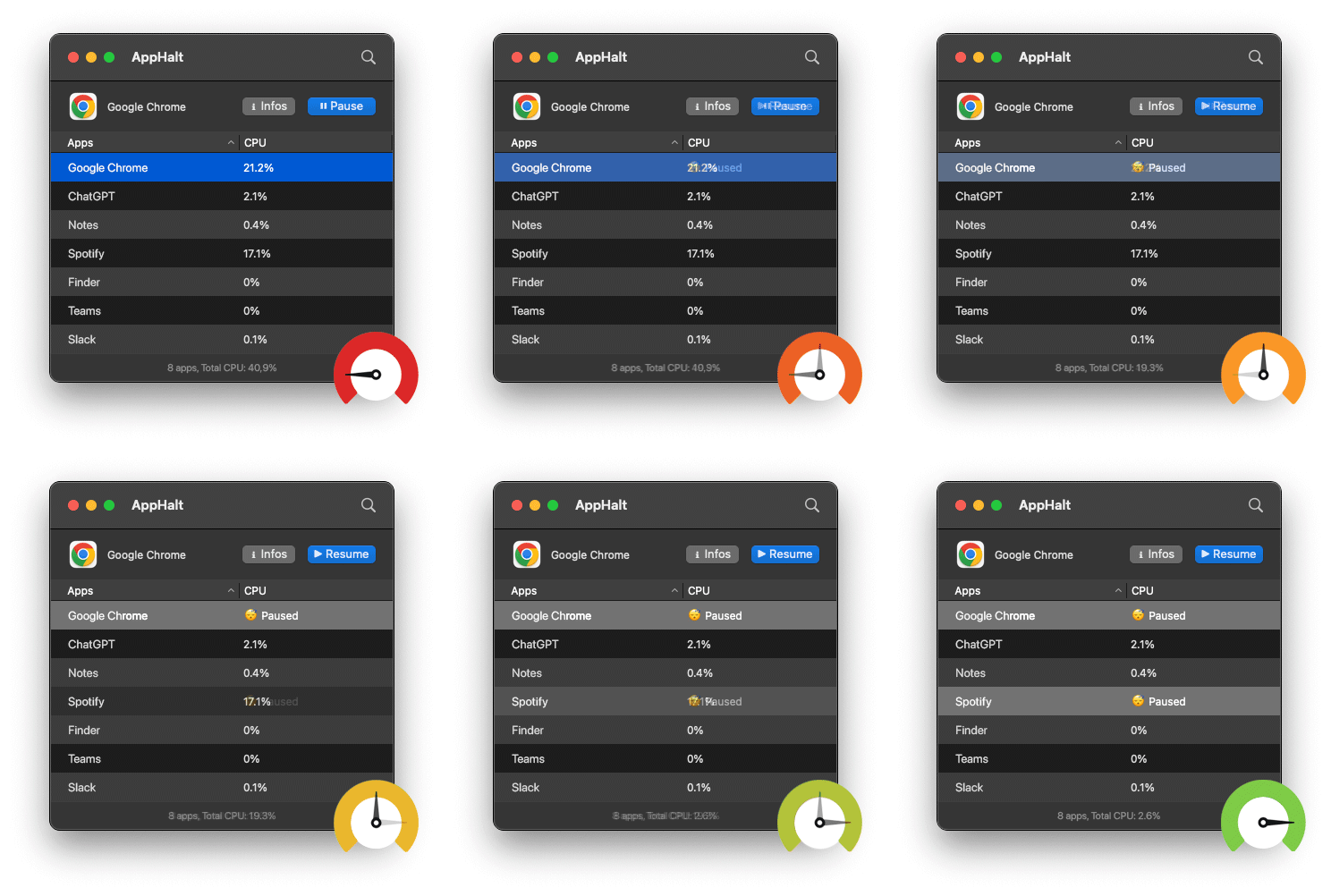
🚀 Reduce Mac CPU Usage with AppHalt
AppHalt helps your MacBook stop wasting CPU on apps you are not using.
Instead of quitting everything or letting every app run in the background, AppHalt gives you a smarter middle ground: pause unused apps, reduce background CPU usage, and help your MacBook feel faster, cooler, and more focused.
✅ Reduce background CPU usage.
✅ Help prevent overheating, fan noise, and battery drain.
✅ Pause unused apps without fully breaking your workflow.
✅ Keep your MacBook feeling faster, lighter, and calmer.
📥 Want your MacBook to stop wasting CPU? Download AppHalt now.
To turn a high CPU reading into an answer, follow this Activity Monitor guide for Mac and compare the CPU, Memory, and Energy tabs.